
An ancient Indonesian value is quietly reshaping how communities care for one another across continents.
There is a word in the Indonesian language that has no perfect translation in English.
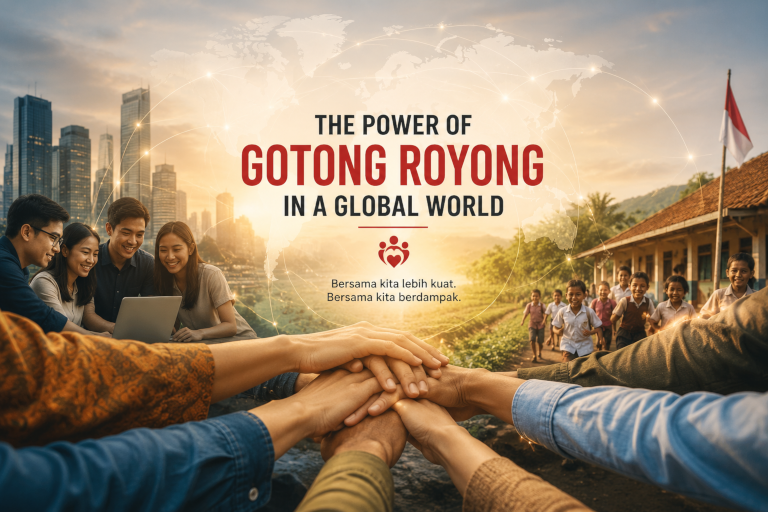
Gotong royong.
Literally, it describes the act of carrying a burden together. In practice, it means something much richer: a way of life in which neighbors do not wait to be asked before showing up, communities do not keep score of who gave what, and no one is expected to face their hardest moments alone.
For generations, gotong royong was the invisible infrastructure of Indonesian village life. When a family’s home burned down, the neighbors rebuilt it. When a harvest needed to be brought in before the rains, every hand in the community helped carry the load. When someone was in need, the community did not debate whether to help — it simply moved.
That spirit did not disappear when Indonesians left home.
It traveled with them.
From the Village to the World
Today, more than 8 million Indonesians live outside their homeland — scattered across more than 100 countries, from New York to Nairobi, from Sydney to Stockholm, from Dubai to São Paulo.
They are doctors, engineers, researchers, teachers, artists, entrepreneurs, students, and workers. They carry Indonesia with them in their values, their language, their food, their longing — and in the deep, often unspoken instinct to look out for one another.
Last year, the Indonesian diaspora sent more than Rp288 trillion back home. The numbers are staggering. But behind every transaction is a quieter story: the student who cut his own food budget so his younger sibling could stay in school. The worker who delayed buying a winter coat so her mother could afford medical treatment. The family that kept two households alive across an ocean on a single income.
The diaspora gives constantly. Generously. Often invisibly.
But generosity flows in more than one direction.
The Challenge of Being Far from Home
Being part of the diaspora is not only a story of success. It is also a story of resilience in the face of challenges that most people back home never see.
A new arrival navigating an unfamiliar healthcare system with no one to guide them. A student facing a housing crisis in a foreign city with no local credit history and no co-signer. A worker who loses a job and discovers that their visa is tied to their employment. A family dealing with a medical emergency thousands of miles from the people who love them.
In these moments, the official systems — embassies, universities, government agencies — can feel slow, distant, or simply not designed for the specific situation at hand.
What fills that gap, again and again, is people. Indonesians helping Indonesians. Gotong royong — carried not by the same village, but by the same identity, the same values, the same unspoken understanding of what it means to be far from home.
What Gotong Royong Looks Like Today
Technology has not changed the spirit of gotong royong. It has simply given it new reach.
An Indonesian engineer in Seattle stays up late to help a newly arrived student understand their lease agreement. A nurse in Amsterdam answers a message from a stranger in Riyadh asking for advice about a medical symptom. A group of diaspora members in a university town organizes a welcoming committee — not as a formal program, but because it is simply what you do when someone needs help getting from the airport to their apartment with four pieces of luggage.
A small business owner in Singapore makes a monthly donation of twenty-five cents a day — less than the cost of a cup of tea — because she knows that when those twenty-five cents come from thousands of people, they become scholarships, emergency funds, and proof that someone is paying attention.
None of these acts require a large budget. None of them require an official title or a formal organization. They require only the willingness to see a need and respond to it — the same instinct that once rebuilt homes in villages and brought in harvests before the storm.
Diaspora Care: Organizing the Instinct
What Diaspora Care does is not invent something new. It organizes something that was already there.
We build the systems, the networks, and the platforms that allow the natural generosity of the Indonesian diaspora to be channeled where it is needed most — reliably, efficiently, and at scale.
Through our volunteer network, experienced diaspora members offer their time and expertise to those who need guidance. Through our mentorship program, those who have navigated the challenges of life abroad help the next generation find their footing. Through our emergency assistance fund, donations pooled from thousands of small contributors become a safety net that can be deployed within hours when crisis strikes.
And through our community-building work, we ensure that no Indonesian who arrives in a new country has to figure everything out alone — that there is always someone who has been there, who understands, and who is willing to say:
“I know how this works. Let me help.”
The Future of Giving — Built on Ancient Wisdom
There is something quietly radical about applying a centuries-old village philosophy to a global diaspora of millions.
It says that community is not a product of geography. That belonging does not require proximity. That the obligation to care for one another does not end when you board a plane.
It says that eight million Indonesians, scattered across every time zone on earth, are not just individuals navigating their separate lives. They are a community — with shared roots, shared values, and the shared capacity to lift each other up.
When thousands of people contribute what they can — a skill, an hour, a quarter a day — something extraordinary happens. Not because any single contribution is large, but because none of them stands alone.
That is gotong royong.
That is the future of giving.
And it starts with all of us.